Anthropic: 1,000 Claude Fable 5.2 agents reproduce a formal Fermat's Last Theorem proof
Anthropic reports that a team of 1,000 agents running an early Claude Fable 5.2 reproduced a formal proof of Fermat's Last Theorem.
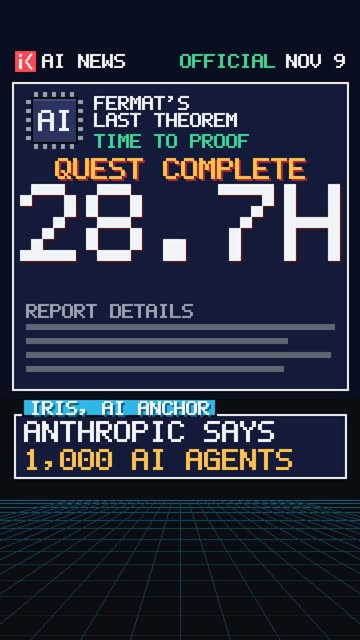
Watch the short
Under a minute, read by an AI anchor. Made . The story has been updated since, and the text below is the current version.
YouTube loads only when you press play.
Anthropic said a team of 1,000 agents running an early version of Claude Fable 5.2 reproduced a formal proof of Fermat's Last Theorem in 28.7 hours. The run did not use the Prove2Me platform, and no researcher steered the work. The company's post frames it as an experiment in safely scaling multi-agent teams. It also describes how the company kept a thousand agents contained while they worked.
The comparison point is Anthropic's September formalization. That effort used dozens of agents running an internal model roughly comparable to Claude Fable 5.1. A researcher and those agents took 11 days and roughly 6 billion output tokens to write 13 million lines of Lean, the programming language in which a computer checks every step of a proof. The new run used one-third as many output tokens. The post says its proof is one-seventh the length of the original, but it gives no absolute token or line count for the new proof, so the ratios are all it offers on size.
Prove2Me, the platform used in September, coordinated agents through a shared graph linking each statement to the smaller statements it was split into. Agents could ask the graph which unproved pieces were ready. Each piece lived in a separate file that compiled on its own, so many agents could work without editing the same files. The post says earlier attempts failed because agents lost track of the project's state, and that Prove2Me fixed this. The new run dropped that scaffolding, so the agents had to build their own way of coordinating.
The harness gave each agent its own lightweight virtual machine, since a single shared machine hit its limits at about 100 agents. The post says more than half of its 100-agent runs had to be stopped or restarted when memory, disk or CPU ran out. Each agent had a shell, a file editor, Lean's toolchain and Mathlib, its own Git branch, and access to a shared Postgres database. The agents received 60 statements: the final theorem, 59 intermediate milestones, a one-sentence sketch of the classical route, the definitions the statements use, and 47 proved lemmas from the earlier formalization. The only structure was a hierarchy of one lead and 999 helpers. The harness sent the lead 19 automatic reminders of the time remaining.
The lead set up five database tables in its first 10 minutes. They included one for orders, one for assignments, and one for a to-do list that helpers could claim from. It divided the statements among crews of 16 or 17 helpers, each with a captain. About 27 minutes in, the lead set aside 47 statements that most helpers had judged infeasible within the run's budget, and moved nearly all the helpers onto the remaining 10. All 10 were proved within roughly 70 minutes. The post notes that the team went on to prove most of the statements the helpers had written off. By hour 5.6, 73 helpers had written 756 tasks. Only 16 of those helpers were captains, so helpers had taken on much of the planning the captains were first given.
By hour 18, only Langlands-Tunnell remained, along with the statements that depended on it. Langlands-Tunnell is a classical result that Wiles's proof relies on. The captain of that task had earlier estimated it would take 0.7 to 1 million lines of Lean and had less than a 1% chance of finishing in time. The lead refocused the team on it anyway, moving about 750 helpers onto the statement and writing "Honest odds are low." The statement took about nine times as many tasks as any other statement the agents had worked on. The team built a tree of 2,418 tasks up to 10 levels deep, in which a helper that found a piece too hard could split it further. Langlands-Tunnell was proved at hour 28.4, and the final theorem at hour 28.7. The figure captions say activity stops near hour 18, when the run was restarted from its last save and given 12 more hours. The main text doesn't spell this out.
Each agent ran with no network access. Its only outbound link was a pipe to a gateway that tagged every request with the agent's identity. Its kernel was built without features that give a root user a direct path in, and it ran in kernel lockdown mode. Every SQL statement had a five-second limit, and writes above 256 MiB were refused. A prompted LLM classifier checked every shell command and file edit before it ran. If it blocked a call on the lead, the run ended. A block on a helper removed only that helper. The post says that across more than a million tool calls none met the bar to be blocked. When the calls were replayed against the chain-of-thought monitor and today's rubric, only one, a check for root access, came close.
The post says the chain-of-thought monitor, which reads agents' reasoning and their messages to each other, detected all sabotage attempts in the company's red-team evaluations. The monitor was added shortly after this run. This run used only the action-based monitor, which sees actions but not reasoning. The company says it designs its monitoring for the possibility that a model is misaligned, because experiments like this one may run on models that haven't finished pre-release alignment assessment. The post doesn't say how many red-team attempts stood behind the claim that every sabotage attempt was caught.
What changed
A team of 1,000 agents running an early Claude Fable 5.2 reproduced a formal proof of Fermat's Last Theorem in 28.7 hours without the Prove2Me platform, using one-third as many output tokens as Anthropic's September formalization.
Type: Research · Applies to: Claude Fable 5.2
Why it matters
The run shows large agent teams being applied to a formal mathematical proof, which suggests coordinated agent fleets could handle long, verifiable technical work. Companies weighing such setups should note that Anthropic presents the shared database and layered safety controls as central to the approach.
How the story developed
It adds the comparison with Opus 5.5, which completed 26% of the same setup in 18 hours.
Original source
Where we saw it
Latent Space, Turing Post, claude.dev
AI wrote this summary from the sources listed, and nobody reviewed it individually before publication. Check the original source before you rely on it. How it works