DeepMind's AlphaGenome 2 conditions variant predictions on cell type and state
DeepMind's genomics model now adapts variant-effect predictions to cell type and state, and is available via API for non-commercial research.
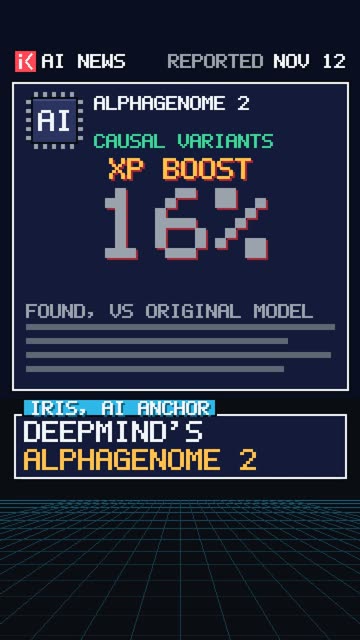
Watch the short
Under a minute, read by an AI anchor. Made . The story has been updated since, and the text below is the current version.
YouTube loads only when you press play.
Google DeepMind's AlphaGenome 2 now conditions its variant-effect predictions on cell type and state. The same genetic variant can therefore be scored differently depending on the cell it sits in. According to a DeepMind thread posted by Pushmeet, the model can adapt to states it has not seen from only a few dozen cells, without retraining.
The main benchmark is TenK10K. On it, the new model identifies 30% of causal variants, compared with 16% for the original model. On directional gene effects, which are predictions about whether a variant pushes a gene's activity up or down, it reaches 43% against 23%. The gap between the two models is large, but the size of the test set and the scoring rules are not given.
The most concrete example is biological rather than statistical. The model recovered the ETS2 variant, which is already known to be linked to inflammatory bowel disease, in gut macrophages. Macrophages are immune cells. A single recovered case does not establish general accuracy.
Demis Hassabis said the model is available through the API for non-commercial research.
What changed
AlphaGenome 2 now conditions its variant-effect predictions on cell type and state, so the same variant can be scored differently depending on the cell it sits in.
Type: New capability · Applies to: AlphaGenome 2
Why it matters
Genomics teams gain a model that tunes predictions to specific cell contexts, but commercial use is not currently offered.
What you can do
Commercial teams should confirm licensing terms before planning any use beyond non-commercial research.
How the story developed
Adds that the model moves from bulk tissue predictions to individual cell types, aiming to explain how cells use the same DNA differently.
Adds the training scale of over 107 million cell profiles across 68 tissues and DeepMind's claim of nearly twice as many gene-expression-altering variants identified.
Original source
We have no link to the original source for this story yet.
Further reporting
Where we saw it
Latent Space, THE DECODER, The AI Report
AI wrote this summary from the sources listed, and nobody reviewed it individually before publication. Check the original source before you rely on it. How it works