Google DeepMind introduces Gemini 4 Hydrogen
Google DeepMind announced Gemini 4 Hydrogen in a company post that reports benchmark results and pricing, though those figures are Google's own.
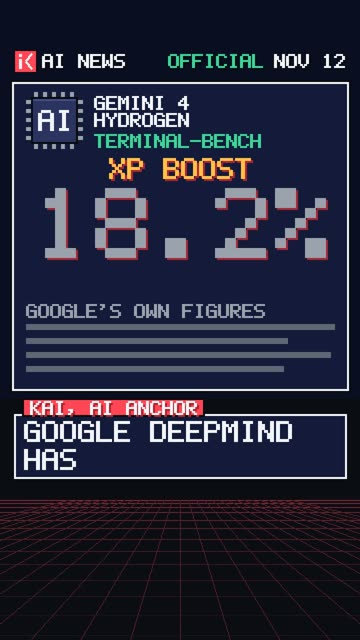
Watch the short
Under a minute, read by an AI anchor. Made . The story has been updated since, and the text below is the current version.
YouTube loads only when you press play.
Google DeepMind has released Gemini 4 Hydrogen, a fast and efficient model the company positions for everyday coding and agentic work. It is not one of its frontier reasoning models. In a post dated November 12, 2026, Koray Kavukcuoglu, SVP of Google DeepMind and Chief AI Architect at Google, said the model brings cutting-edge intelligence to everyone. The company places Hydrogen beside Gemini 4 Carbon and Gemini 4 Argon, which it says excel at deep, long-horizon reasoning. Hydrogen, by contrast, is built for rapid execution across agentic workflows. Pricing is $1.50 per million input tokens and $7.50 per million output tokens, flat across the full 1 million-token context window.
On the Artificial Analysis Intelligence Index, Hydrogen scores 51 at its default high thinking level, against 50 for Argon. At the new xhigh setting, it rises to 54. The lead over Argon at the default setting is one point. Users can pick among four thinking levels, low, medium, high and xhigh, to decide how much reasoning a task receives. The post says that trade-off is paid for in both wait time and cost. The comparisons that follow are against Gemini 3.8 Flash, the model the post targets for migration. Against it, Google says Hydrogen finishes tasks 2.5 times faster at its default setting, scores 57% on Terminal-Bench 4.1 against 18.2%, and cuts fabricated claims by more than five times. Partners testing on complex graphs, SQL and data-heavy enterprise workflows reported 2x to 2.8x speedups and 12% to 23% lower token usage, according to the post.
Google describes Orchestrator in Google Antigravity, which switches between Carbon and Hydrogen within the same session. Carbon handles architectural judgment, while Hydrogen writes code, runs tests and verifies changes. On Terminal-Bench 4.0, Orchestrator reached near-Carbon task success rates. On average, it used 24% less quota and completed tasks 19% faster. Those figures come from version 4.0 of the benchmark, while the migration numbers come from 4.1, so the two sets of results are not directly comparable. For parallel work, the post says Carbon can coordinate while Hydrogen runs worker and verifier agents across isolated workspaces.
Google also cites results on several other evaluations. Hydrogen ranks fifth on Agent Arena, which the post describes as arena.ai's live benchmark. It leads its class on HLE-Diamond at 58.8%, and ranks first overall on the Vals Tax Agent Bench at 52.3%. It ties for first on the Vals Legal Research Bench at 55.8%. On the new Multimodal Knowledge Agent benchmark, which the post introduces, Hydrogen scores 53.4%. On Agents' Last Exam v1.1, it scores 71.6%. The post does not describe how many tasks these evaluations contain or how they were scored, so the percentages are Google's own reporting.
The safety section makes comparative claims. Google says Hydrogen reduces overreach in agentic tasks by up to 81% and under-service by up to 79%. It cuts misaligned actions and task shortcutting across tool-use and coding evaluations by 12x, and is up to 2x less likely to bypass permission boundaries when tasks are impossible or blocked. It reports a 96.7% honesty rate on what it calls its internal agent honesty evaluation, which the post does not describe in detail. It also reports 99.9% chain-of-thought legibility across more than 200,000 audited turns, more than 2.3x better resilience on the Gray Swan IPI benchmark against indirect prompt injection, and false refusals on HealthBench Pro below 0.4%. The safety comparisons are framed against Gemini 3.8 Flash, and the post names no competing models for these figures.
Availability is staged by audience. Developers can build with the Gemini API in AI Studio and the paid tier in Android Studio. Paid Google AI Pro and Ultra subscribers can use it in Google Antigravity. Enterprises can deploy it through Gemini for business, Google Antigravity and Gemini in Google Sheets for eligible business subscriptions. For consumers, it is available in the Gemini app model drop-down and in Google Search for all users, while Gemini in Google Sheets starts with Google AI Pro and Ultra subscribers. Free users in the Gemini app receive it through auto model selection when the system judges it the appropriate model for a prompt. The post says the rollout is global and starts today.
What changed
Google DeepMind releases Gemini 4 Hydrogen, a fast and efficient model for everyday coding and agentic work that is not one of its frontier reasoning models, and it replaces Gemini 3.8 Flash as the migration target.
Type: New capability · Takes effect: Thursday, November 12, 2026 · Applies to: Gemini 4 Hydrogen, Gemini API, AI Studio, Android Studio, Google Antigravity, Gemini for business, Gemini in Google Sheets, Gemini app, Google Search
Why it matters
Teams that plan model choices around Google's roadmap should wait for the capability and pricing details before changing their plans.
How the story developed
Adds that it outscores the larger Argon model four weeks after Argon's launch and targets everyday tasks at lower prices.
Adds independent Artificial Analysis and Arena results and user-reported caveats on reasoning cost and benchmark weaknesses.
Adds the scheduled December 1 price increase for Carbon and Argon, the cached input price, and a price comparison with Claude Haiku 5.5 and GPT-6 Luna.
Original source
Further reporting
Where we saw it
Google DeepMind, Latent Space, Simon Willison, THE DECODER
AI wrote this summary from the sources listed, and nobody reviewed it individually before publication. Check the original source before you rely on it. How it works