Meta releases Muse Ember, priced at $0.10 and $0.50 per million tokens
Meta's Muse Ember handles text, images, audio and video, and costs $0.10 per million input tokens and $0.50 per million output tokens for up to 200K input tokens.
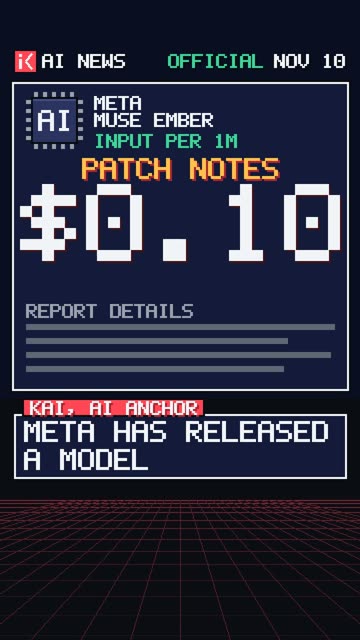
Watch the short
Under a minute, read by an AI anchor. Made . The story has been updated since, and the text below is the current version.
YouTube loads only when you press play.
Meta released Muse Ember on Monday. The model accepts text, images, audio and video, and costs $0.10 per million input tokens and $0.50 per million output tokens for up to 200K input tokens. Meta positions it for repeated jobs such as tool calls and document processing. Turing Post called the pricing cheap.
The gap between input and output prices matters here. Input tokens are the text, images, audio or video a developer sends to the model, while output tokens are what the model generates back. At these rates, output costs five times as much as input. The announcement material available here does not say how pricing works above 200K input tokens, and the linked pricing page was not among the pages provided.
What changed
Meta released Muse Ember, a model that accepts text, images, audio and video, priced at $0.10 per million input tokens and $0.50 per million output tokens for up to 200K input tokens.
Type: New capability · Applies to: Muse Ember, Google Cloud
Why it matters
A low-cost multimodal model aimed at high-volume tool calls and document processing could cut costs for pipelines that run many small jobs.
What you can do
Test Muse Ember on your highest-volume tool-call or document workloads and compare cost and quality with your current model.
How the story developed
Artificial Analysis now gives the score: 36 on its Intelligence Index, matching Haiku 5.5 (max) at about a third of the cost per task.
It adds that Muse Ember launches on Google Cloud alongside Muse Wonder and Muse Spark 1.3, and that an early checkpoint was tested anonymously before release.
Original source
Further reporting
Where we saw it
Forward Future (Matthew Berman), Latent Space, Simon Willison, The AI Report, Turing Post
AI wrote this summary from the sources listed, and nobody reviewed it individually before publication. Check the original source before you rely on it. How it works