MiniMax says its Cyber model found practical breaks in several cryptographic schemes
MiniMax says its Cyber model automatically found flaws and built working attacks on NIST candidates and peer-reviewed cryptographic schemes.
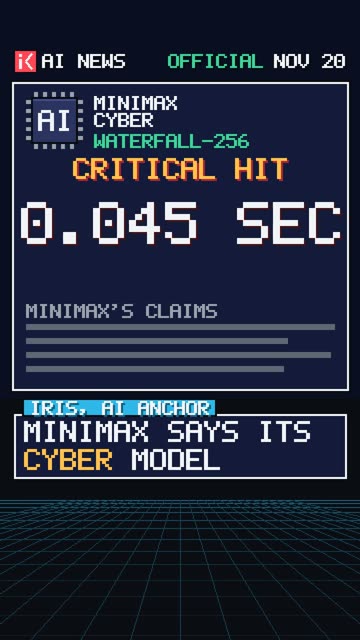
Watch the short
Under a minute, read by an AI anchor. Made . The story has been updated since, and the text below is the current version.
YouTube loads only when you press play.
MiniMax said its research team used its Cyber model for automated cryptanalysis. The post says the model found several previously unknown structural flaws in modern cryptographic schemes, turning some theoretical attacks into practical breaks. The most specific claims concern NIST candidates that the post says had no known practical attacks before. The post also reports more than a dozen implementation bugs in their reference code that it says were previously unreported.
The evaluation used CryptanalysisBench, a NeurIPS 2026 benchmark built by researchers from ETH Zurich, Anthropic and collaborators from four NIST competitions. Tier 2 holds 135 publicly reviewed schemes with no known practical attacks, plus 7 production-strength challenge schemes. MiniMax says it used the same setup as the original paper. The post argues that the benchmark separates reasoning from recall. It says Cyber's independent reasoning traces show it working directly from the mathematics rather than reproducing published attacks.
Waterfall-256 and Blender-256 are both NIST SHA-3 candidates, and the two claims differ in kind. For Waterfall-256, the post says prior work was purely theoretical and no colliding message pairs had been constructed. In a blind run, Cyber found collisions across all output lengths in 0.045 seconds on a single core. For Blender-256, the post says full-round collision resistance had stood unbroken since submission, and that earlier models had only exploited 64-bit word-size bugs in the C implementation. Cyber found those bugs and also broke the underlying construction, producing full-round collisions in 0.36 to 2.3 seconds on a single core. The post claims both a flaw in one implementation and a break of the design. Those are different findings.
The post's key-recovery claims for LOCKER and ROLLO-I rest on a rank-metric decoding problem. The method works as follows. After Cyber patched buffer bugs in the reference code, it attacked the underlying mathematical problem directly rather than the code. On LOCKER, the post says Cyber shrank the solver matrix from 42 petabytes to 58 megabytes and recovered the shared secret across all parameter sets in 2 seconds. For ROLLO-I-128, the post says Cyber recovered an equivalent secret key from the public key in about 6 seconds on a single core. ROLLO reached Round 2 of the NIST post-quantum process.
The implementation bugs follow a similar pattern. In DRS, a Round 1 lattice signature scheme, the post says a verification check used logical AND (&&) where bitwise AND (&) was written, an error it says earlier reviews missed. In C, && tests whether both sides are true, while & combines bits. A check written with the wrong operator can therefore pass on values it should reject. The post says Cyber used this to bypass checks and forge signatures across all parameter sets with zero signing queries, needing only the public key, in 0.1 to 0.8 seconds. For RQC-128 and LAC-128, both Round 2 candidates, the post says Cyber recovered plaintexts from ciphertexts using randomness-sampling leakage in 0.41 seconds for RQC-128. For LAC-128, it says Cyber found a decryption-failure branch that omitted a ciphertext copy and hashed uninitialized memory into the derived key, which the post says breaks chosen-ciphertext security.
The peer-reviewed results involve designs published with security proofs. The post says Cyber found gaps in those proofs and edge cases in the designs. COLM, a CAESAR authenticated encryption winner published in the Journal of Cryptology in 2024 after five years of public review, had no practical attacks in the standard model according to the post. Cyber found a structural flaw and built a forgery requiring no decryption queries, producing a valid ciphertext after two encryption queries. For SBC-VOLE, a post-quantum signature scheme from ASIACRYPT 2025, the post says Cyber turned a flaw in its signature-size reduction mechanism into key recovery. It recovered the full secret key from a single known signature in 0.06 seconds across all 6 parameter sets and both code variants in the official repository.
ARADI, a low-latency memory encryption cipher attributed to the NSA in 2024, is where the post's round counts deserve scrutiny. The post says its parameter design criteria were not published, and that prior practical key-recovery attacks reached 5 rounds. Cyber extended practical key recovery to 8 rounds on a single core, recovering the full key in 2.4 to 16.0 seconds. For 9 to 12 rounds, the post claims new theoretical records.
The public-key claims are about solvers rather than design flaws. On the TII McEliece challenges, which test instances based on the McEliece cryptosystem underlying the NIST candidate Classic McEliece, the post says Cyber's new algebraic method shrank equation systems by up to 6.59x. It says Cyber recovered secret keys for 94 instances, 55 of them previously unsolved. It solved instances with prior public records in 1.80 to 5.36 seconds on a single 64-core server. The post puts that at a 6,180x to 43,400x speedup over the CRYPTO 2026 record of 9.20 hours and over Anthropic's prior multi-GPU cluster solver. The post does not state what hardware the CRYPTO 2026 record used, so the baseline setup for that comparison is not stated.
The HAWK result builds on earlier work. The post says Anthropic had solved the Lattice Isomorphism Problem for HAWK-256 in 3 hours and 42 minutes on a 96-core server, which led the HAWK authors to withdraw from the NIST competition. Cyber, the post says, improved both the algorithm and the implementation. It lowered bit-security estimates across all HAWK parameter sets by another 9.3 to 23.8 bits and recovered an equivalent secret key in 30 minutes on a single core, about a 690x gain in core-hours. Bit-security estimates express how much work an attack needs in powers of two, so each bit removed halves the remaining work an attacker must do.
The post says the work focuses on academic designs, past competition candidates and public challenge parameters, and that it does not affect deployed cryptographic standards. It also says the findings were shared with the authors of the affected schemes in advance. MiniMax says it released technical reports and proof-of-concept code at github.com/MiniMax-AI/Cyber and offers testing access to qualified researchers and developers via developer@minimax.io. The GitHub page the post links to currently reads 'This repository is empty.'
What changed
MiniMax says its Cyber model found previously unknown structural flaws and built practical attacks on several cryptographic schemes, including NIST candidates, and reports implementation bugs in reference code.
Type: Security · Applies to: Waterfall-256, Blender-256, LOCKER, ROLLO-I-128, DRS, RQC-128, LAC-128, COLM, SBC-VOLE, ARADI
Why it matters
The claims suggest AI models can now find and exploit flaws in cryptographic designs and reference code at speed. That shifts the bottleneck toward human verification of security margins. Teams planning post-quantum migration should expect more cryptanalysis results to arrive faster.
What you can do
Security leads evaluating post-quantum or lightweight cryptography should track the disclosures and the scheme authors' responses. MiniMax says deployed standards are not affected.
How the story developed
Adds the specific schemes and results MiniMax lists, including timings, claimed speedups, its disclosure process and the researcher access program.
Original source
Where we saw it
MiniMax
AI wrote this summary from the sources listed, and nobody reviewed it individually before publication. Check the original source before you rely on it. How it works