OpenAI says GPT-6 models can design protein structures and sequences
OpenAI reports that GPT-6 models design protein structures and sequences using reasoning and code, with lab tests showing evidence of binding across five targets.
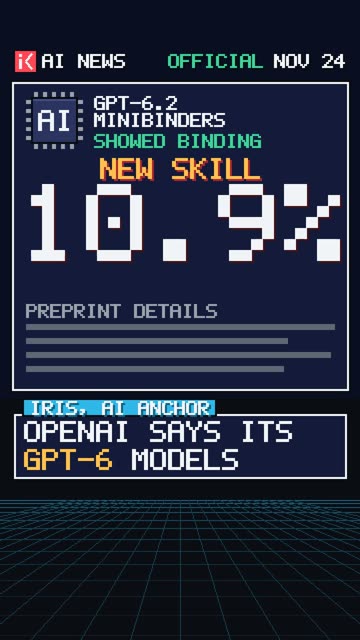
Watch the short
Under a minute, read by an AI anchor. Made .
YouTube loads only when you press play.
On November 24, 2026, OpenAI said its GPT-6 family can design new protein shapes and the sequences of their chemical building blocks using only reasoning and code. The models did not call specialized biology models to generate those designs. The evidence is a preprint, a set of computational benchmarks run by OpenAI, and lab experiments carried out with its research partner Onava.
The company's argument starts from how protein design usually works. A protein's amino acid sequence helps determine how the chain folds into a three-dimensional shape, and that shape largely determines what the protein does. Researchers have typically coordinated several specialized models. Each accepts particular inputs and cannot easily take new kinds of constraints without changes to its software or additional training. OpenAI's claim is that a general-purpose model can take those requirements in plain language and adjust through prompting alone. The post says the models' written reasoning and code suggest they draw on math, physics, chemistry and biology. It describes one case in which GPT-6.2 proposed how a minibinder might interact with the protein IL-7Rα, then wrote and ran code to explore candidate shapes. These readings of the reasoning traces are OpenAI's interpretation.
In the first lab experiment, Onava made proteins based on GPT-6.2's three-dimensional designs, which were produced without specialized protein AI models. Specialized tools still handled the sequence work. The post says SolubleMPNN suggested sequences for each design, and other specialized models helped select candidates. Of 322 minibinders tested against five targets, 35 (10.9%) tested positive for binding. The hits were 5 for PD-L1, 3 for IL-7Rα, 1 for TrkA, 8 for VEGF-A and 18 for IL-17A. Computationally, GPT-6.2's designs scored slightly lower than those from RFdiffusion, a specialized model. The post notes that the original RFdiffusion study reported higher hit rates. It also says that rates depend heavily on how strictly designs are filtered and how binding is defined.
The second experiment asked whether GPT-6.2 could design the sequences itself. The researchers withheld the original amino acid sequences of known minibinders and asked for new ones. Binding appeared in 75 of 88 designs for MDM2 (85%), 26 of 42 for VEGF-A (62%) and 8 of 59 for PD-1 (14%). The proposed sequences also differed from the originals by a median of 50% for VEGF-A, 43% for MDM2 and 15% for PD-1. For three unpublished shapes, 14 of 107 proteins (13.1%) showed binding. In those cases, however, a specialized model, ProteinMPNN, had supplied one sequence for each shape. For one PD-L1 structure, GPT-6.2 produced two sequences that differed from the original at 52 and 58 of 90 amino acids, and from each other at 44 positions. OpenAI says this shows the capability goes beyond memorization. The experiments measured binding, though. The post doesn't say whether any of these proteins performed a function.
The antibody work centers on affinity maturation, in which the binding loops of an antibody are reworked to grip a target more tightly or more selectively. OpenAI tested a first step: designing new loop sequences that still bind the original target. For six small antibodies, VHHs, that bind IL-4Rα, the model received the predicted structure and most of the sequence, with the three binding loops left out. Of 182 designs tested, 128 (70%) showed signs of binding. In a further test on five therapeutic antibodies, the model changed about half the amino acids in each of three loops. The redesigned fragments were then tested as pieces. Of 272 fragments, 179 (66%) still bound the original target, PD-1 or PD-L1.
The computational benchmarks are where the comparisons with specialized models are most explicit. On motif scaffolding, which asks a model to build a protein around a fixed arrangement of amino acids, 43.7% of designs from the latest internal model passed across 30 MotifBench challenges. RFdiffusion passed 27.8%. The post calls this a preliminary analysis. On designing proteins to a specified CATH fold across 200 challenges, the internal model passed 18.9% against 17.1% for Proteina. For docking, which predicts where a small molecule sits on a protein, GPT-6.2 closely matched the observed position and orientation in 93% of scored predictions on the PoseBusters dataset. The internal model reached 96% and DiffDock-L reached 50%. On the Scarpino dataset of 179 structures, GPT-6.2 scored 92%, the internal model 97% and DiffDock 60%. The post also says that predicting a complete protein structure remained a clear weakness.
The antibody-binding results compare OpenAI's own model generations rather than outside tools. Using the DockQ score, where higher values indicate a closer match to the experimentally observed arrangement, the mean rose from approximately 0.05 for GPT-5.6 to 0.28 for GPT-6. It reached 0.57 for GPT-6.2 and 0.81 for the latest internal model, each at its highest evaluated compute setting. That trend shows improvement across OpenAI's own generations. The excerpt contains no specialized antibody-docking baseline to compare against. The leading results come from an internal research model, and the post's text doesn't say when, or whether, it will be released.
What changed
According to OpenAI's preprint, GPT-6 models can now design new protein structures and their sequences using only reasoning and code, without calling specialized biology models.
Type: Research · Applies to: GPT-6, GPT-6.2
Why it matters
If the reported binding results hold up, general-purpose AI models could take on protein-design work that was previously done with specialized tools. Companies in drug discovery and biotech should treat the claim as unverified until more detail is published.
Original source
Where we saw it
Latent Space, OpenAI
AI wrote this summary from the sources listed, and nobody reviewed it individually before publication. Check the original source before you rely on it. How it works