OpenAI uses GPT-6 Astra and Luna to run administrative work in US healthcare
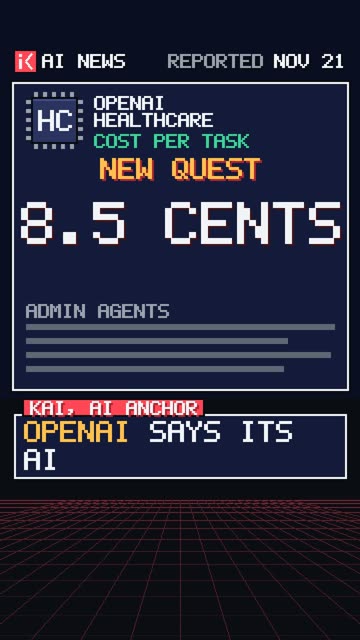
OpenAI says its models operate existing hospital software and insurance portals, and that a prior authorization costs about 8.5 cents with Luna.
Watch the short
Under a minute, read by an AI anchor. Made .
YouTube loads only when you press play.
OpenAI is pitching GPT-6 Astra and GPT-6 Luna as digital clerks for US healthcare administration. The agents operate the hospital software and insurance portals staff already use. The company says Luna completes a task for about 8.5 cents, 98% less than Astra. The 8.5-cent figure is a per-task cost on a benchmark of administrative work, and the clinical results come from OpenAI's own evaluation.
The approach targets a gap that APIs leave open: EHR and payer-portal tasks that APIs don't reach. OpenAI's computer-use agents therefore work the way a person does. The Decoder put it as clicking, typing and moving between applications, using mouse clicks and keystrokes. OpenAI's demo starts with a patient message about lower back pain. The agent reads the visit notes, physical therapy records and prior imaging in the electronic health record, then drafts an MRI order, an encounter note and a reply to the patient. It then fills out a prior authorization request in the insurer's portal. A clinician or authorization specialist reviews each draft before anything is sent.
OpenAI's clinical evaluation had Astra work through tasks from electronic health record inboxes. Reviewers judged 99% of 325 tasks clinically safe, where safety meant whether inaccuracies, omissions or actions could plausibly lead to patient harm. Physicians rated helpfulness on a five-point scale and chose very or extremely helpful in 93% of 646 assessments. One example in the post is an arm fracture case in which the model used the child's documented weight and clinic dose to draft ibuprofen instructions. It saved the caregiver reply as an unsent draft and wrote a separate unsigned note, so the dosing advice still required clinician approval. The post describes these reviews as OpenAI's evaluation, and it doesn't break down the reviewers or the failure cases.
The administrative results rest on an outside benchmark. HealthAdminBench, which OpenAI credits to Stanford researchers, measures performance on common administrative workflows such as prior authorizations, appeals and medical equipment orders. Astra earned 94.3% of the available rubric points and Luna earned 91.8%. Both models ran at maximum reasoning effort.
OpenAI names several partners. CVS Health says its agents handle referrals and specialist consults across separate systems, and that one agent cleared a months-long document-sending backlog over a weekend. Another handles the system steps for tens of thousands of consults each day. CVS is open-sourcing Agent Kit, which is built on OpenAI's Agents SDK. Cigna says case managers previously had to navigate more than 10 separate clinical and administrative systems to gather a member's context, and that computer use can now assemble that information in seconds. Ambience demonstrated a control in which the agent stops and asks the clinician when the chart is ambiguous, then waits for approval before submitting. Assort uses the agent in Codex to mark a referral as visit scheduled in Athena, a step its API integration could not complete. Abridge's inpatient discharge work is described as planned rather than deployed.
On data handling, OpenAI says organization data is not used to train its foundation models, and that ChatGPT for Healthcare provides role-based access controls and audit logs. Organizations handling protected health information must use eligible services covered by a Business Associate Agreement and the required security and retention settings. The Decoder noted that the announcement doesn't say where the screenshots CVS reviews are processed or how long they are stored, and that it doesn't address the European General Data Protection Regulation. The offering currently targets the US market. The same outlet wrote that adoption will depend on how reliably the agents connect to existing systems, whether they can be monitored in practice, and whether a human must approve clinically or legally relevant steps.
What changed
OpenAI is offering GPT-6 Astra and GPT-6 Luna as computer-use agents that operate existing hospital software and insurance portals for US healthcare administration tasks.
Type: New capability · Applies to: GPT-6 Astra, GPT-6 Luna, US market
Why it matters
Healthcare administration is a large, cost-heavy workflow, and the reported per-task figure gives buyers a concrete benchmark for automating it.
What you can do
Compare the current cost per prior authorization with the 8.5 cent figure before scoping any automation project.
Original source
Further reporting
Where we saw it
THE DECODER
AI wrote this summary from the sources listed, and nobody reviewed it individually before publication. Check the original source before you rely on it. How it works