Replit says its agents rebuilt a rival's features 1:1 after studying its workflows
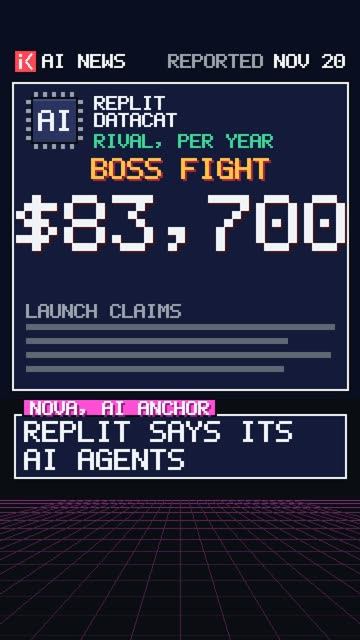
Replit says its agents studied thousands of a competitor's workflows and rebuilt the competitor's features 1:1, while pitching its DataCat product against an $83,700 monitoring bill.
Watch the short
Under a minute, read by an AI anchor. Made .
YouTube loads only when you press play.
Replit says its AI agents explored thousands of workflows in a rival observability platform and rebuilt that platform's features "1:1". The company is using the result to sell DataCat, a free self-hosted monitoring product, against a competitor's $83,700 annual bill. A November 17 post on X from Replit's account pitched DataCat as an alternative to "the leading observability platform" without naming it. The post says Replit Missions, the company's agent-swarm product, built DataCat, and it links to the public repository on GitHub.
The repository gives readers something concrete to test. DataCat is a monitoring application licensed under Apache 2.0. Teams can search logs, follow a request across services, and send alerts to Slack. It accepts OpenTelemetry data and traffic from Datadog agents, and its documentation names Datadog when describing that compatibility. The documentation is more precise about parity than the launch post. It lists two tested Datadog agent versions, 7.56.2 and 7.85.4, and says agents from 7.57 through 7.84 were not tested individually. Agents that send traces in a format DataCat cannot read receive a 422 error instead of being silently accepted. The phrase "1:1" covers a lot of ground. Accepting data in a familiar format is one test. Delivering the alert an engineer relies on during an outage is another.
The sharper question is how the agents studied the rival product at all. State of AI reported that lawyer and software engineer Seth Fenster asked whether Replit had advertised a terms-of-service violation. State of AI cited Section 8.2 of Datadog's public subscription agreement, which restricts customers from using its services or documentation to develop competing products, including by copying features. The article notes that Replit's announcement does not say which account, permissions or agreement the agents operated under, and those details matter to any breach claim. The Apache license tells developers what they can do with DataCat now, but it says nothing about the access Replit had when it built it.
For engineering leaders, the most interesting part of the pitch comes at renewal. A team running a handful of dashboards and alerts can now price the work of running those functions itself. State of AI pointed out, though, that the comparison still has to include a storage bill, someone to maintain the service, and evidence that alerts arrive reliably under the team's own traffic.
What changed
Replit released DataCat, a free self-hosted monitoring product under Apache 2.0 that accepts OpenTelemetry data and traffic from Datadog agents.
Type: New capability · Applies to: DataCat, OpenTelemetry
Why it matters
Buyers who rely on AI agents to copy or reproduce competitors' products should ask what access those agents had to third-party systems and data.
What you can do
Ask vendors whose agents study or replicate other products what data and system access those agents were given.
Original source
- x.comReplit ⠕ on X: "The leading observability platform wants $83,700/yr just to monitor your app and catch issues. So Replit Missions built DataCat: https://t.co/vM
- github.comGitHub - replit/datacat: Self-hosted observability: metrics, logs, traces, dashboards and alerts. Stores data in PostgreSQL or ClickHouse. Accepts OpenTelemetry
Further reporting
Where we saw it
State of AI (Melissa Rosenthal)
AI wrote this summary from the sources listed, and nobody reviewed it individually before publication. Check the original source before you rely on it. How it works