Stanford researchers unveil TRACER, an AI system that reviews ICU video to flag delirium
A Stanford-led team describes TRACER, which combines continuous ICU bedside video with electronic health records to help clinicians spot early signs of delirium.
Watch the short
Under a minute, read by an AI anchor. Made .
YouTube loads only when you press play.
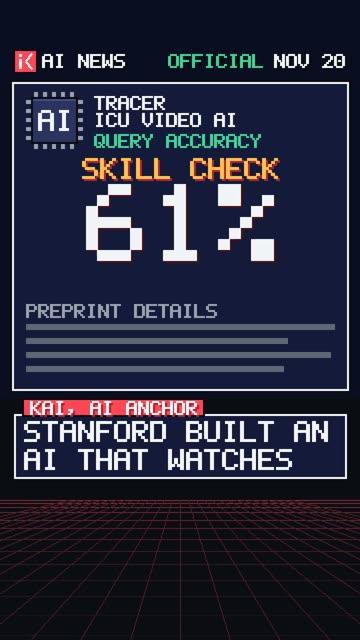
Stanford researchers have described TRACER, a system that watches ICU patients on video around the clock and pairs what it sees with their electronic health records to flag possible delirium. The team's preprint reports 85% action-detection accuracy and 61% accuracy on clinician questions. It also says patients who screened positive for delirium showed markedly lower purposeful activity across a cohort of 280 patients. The work was posted to arXiv on 15 October 2026, and Stanford HAI published its write-up on 20 November 2026.
The motivation is a timing problem. Delirium is common among ICU patients, especially those on ventilators, and is linked to cognitive impairment and a higher risk of death. Clinicians typically check on patients only a few times a day. Rounds often last only a few minutes per patient, with bedside questions such as what day it is. The Stanford HAI write-up notes that the most severe form of the condition is a lack of activity, which makes it hard to detect by asking questions. The team's premise is that the signal is in movement and in inactivity, so a system that records behavior continuously could catch changes that rounds miss.
Each TRACER installation uses two cameras over an ICU bed recording 15 frames per second. Recording continuously at that rate produces a large volume of data, and the HAI post says the average ICU stay lasts three and a half days. To reduce the load, the system samples the footage at one-minute intervals and labels each sampled minute against 15 actions the authors call atomic, such as hand-to-face movement, talking or lying still. A perception model labels each minute. A second model summarizes each hour into a report. An LLM agent answers questions by calling tools over the minute-level timeline, the hourly reports, the health records and the raw video. The arXiv abstract describes the design as a training-free harness, meaning the models are used as they are rather than fitted on patient data. The HAI post says that because no patient data was used to train TRACER, it can be shared with other ICUs without raising patient privacy concerns. It adds that building on a foundation model is intended to reduce one-off solutions that do not generalize.
The action-detection number, 84.8% in the abstract and rounded to 85% in the HAI post, was measured on 397 annotated one-minute clips covering the 15 actions. The question-answering number, 61.0%, comes from 144 clinician-informed multiple-choice questions grounded in 264 hours of video and records from two ICU patients. The abstract says the strongest baseline using the same backbone scored 49.3% on those questions, a comparison point the HAI post leaves out. The 280-patient cohort is different evidence. The abstract says the roughly 60,000 camera-hours yielded significantly less purposeful activity in patients with a positive delirium assessment (p < 0.0001). That shows an association between a screening label and recorded activity. It does not show that the system detects delirium early or improves outcomes. The HAI post's claim that TRACER could enable interventions is framed as a possibility, from Paul Tang.
The question-answering benchmark rests on two patients. A 61% score means the agent gave wrong answers in roughly four of ten cases, which the authors call room to optimize. The paper's example answer about a patient's activity peaking at night is a single illustration, not a measure of reliability.
The public release is partial. A GitHub repository for the paper contains the code, the prompts, the tools and a demo that runs on a synthetic stay and a generated sample video. The README says the video, the health records, the cohort's minute-level records and the 397 annotated clips are not included, because they are protected health information and cannot be shared under the study's approval. A reader who wants to reproduce the cohort findings cannot do so from the repository. The demo tests the software pipeline rather than the clinical claims.
What changed
Stanford researchers described TRACER, a prototype that pairs continuous ICU bedside video with electronic health records to flag possible delirium.
Type: Research
Why it matters
Hospitals considering bedside video AI now have a published prototype that links continuous activity data to clinical records. Its 61% query accuracy shows it is far from clinical grade. Its training-free design, which the authors say avoids patient-data training, could make cross-site deployment easier if validation holds up.
What you can do
Health-system leaders evaluating bedside video monitoring could ask vendors for independent validation data on query accuracy and for their patient privacy safeguards before any pilot.
Original source
Where we saw it
Stanford HAI
AI wrote this summary from the sources listed, and nobody reviewed it individually before publication. Check the original source before you rely on it. How it works