TypeSafe AI launches Jev, a "System One" decision model it says never hallucinates
TypeSafe AI says its Jev decision model is faster and cheaper than LLMs and cannot hallucinate, claims that outside testing only partly supports.
Watch the short
Under a minute, read by an AI anchor. Made .
YouTube loads only when you press play.
TypeSafe AI released Jev on 15 September, calling it a "System One model" that is cheaper and faster than large language models and cannot hallucinate. The company claims end-to-end response latency of 70 to 500 milliseconds, compared with several seconds or more for typical LLMs. An independent pre-print supports the speed gap, but the no-hallucination claim holds only in a narrow sense. The startup recently raised $870 million at a valuation of $7.5 billion. Rivals including Cloudflare, Amazon, OpenAI and Microsoft have since released "decision models" of their own.
The pre-print was co-authored by Ramayya Krishnan, a Carnegie Mellon professor of information systems. It found that Jev had a median latency of 150 milliseconds across benchmarks designed to gauge decision accuracy, including RewardBench and JudgeBench. OpenAI's GPT-6 Astra, the company's most capable model at the time, had a median latency of 1.89 seconds. According to its blog, the company's own published evaluations are generally run from its laptops on the West Coast.
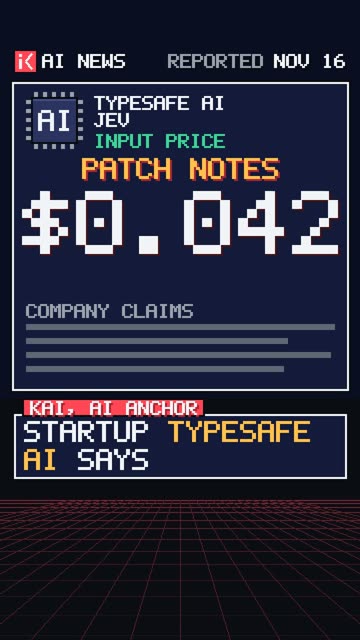
A faster reply is often a cheaper one, because it needs less compute time. IEEE Spectrum notes that this is reflected in TypeSafe AI's pricing. The company charges US $0.042 per million input tokens and nothing for output tokens. IEEE Spectrum cited GPT-6 Astra at $10 per million input tokens and $50 per million output tokens, and GPT-6 Luna, a variant built for fast, inexpensive inference, at $0.10 and $0.50. TypeSafe's blog says it expects its prices to fall, and it concedes it cannot prove they are not subsidized. Its headline claim of 193.6 times faster and 444.6 times cheaper comes from workflows built by its own capabilities team, judged against the average of GPT-6 Astra and Fable 5.1. The blog acknowledges that this reference favors OpenAI and Anthropic models.
Chen attributes the speed to how the model produces output. An LLM generates text one token at a time, with each token conditioned on all the previous ones, until it reaches an end token. Michelle Chen, a group product manager at Cloudflare, described the alternative used by Cloudflare's open-weights Clef: the model makes a single forward pass over the inputs and then produces one output. TypeSafe AI has offered few details about Jev's internals, but Clef, which is based on Alibaba's Qwen LLM, is an example of the approach. Decision models like Clef keep an LLM's neurons and transformer-based architecture, and still take tokens in and put tokens out. What changes is the output stage, which is constrained to a predefined set of options. Zhongyu Wei of Fudan University, a co-author of a study benchmarking decision models, said Jev chooses from options such as A, B and C and returns probabilities alongside its choice.
Chen said decision models are almost a rebranding of classifiers, the older class of models that sort data into categories and are used in spam filters and face detection. The difference, according to independent developer Matt Mastracci, is generalization. Classifiers were traditionally trained for one domain, while decision models keep an LLM's general knowledge, so a single model can be pointed at many problems. Chen said teams that once needed to gather data, build a machine learning team and fine-tune a classifier can now use one decision model across Cloudflare's uses, including spam pull requests, phishing emails and prompt-injection detection.
The hallucination claim holds only in a narrow sense. LLMs can hallucinate because they sample from a huge vocabulary, so a low-probability token can push a response off course. A decision model calculates probabilities only among predefined answers and picks the most likely one, so it cannot produce an invented answer. Krishnan cautioned that "eliminating hallucinations in the output does not eliminate errors in decision-making." In his team's tests, Jev performed well when the answer could be easily reached by reading the prompt, but performance dropped off when the judgment required math or a logic puzzle. Wei's group found that the best decision models slightly beat LLMs on document understanding and scored close to them on tool use. They fell behind in domains requiring expertise in medicine, finance and law. Wei said reasoning is a key factor, though some LLMs performed well without it, and that training methods matter too.
Krishnan's team also tested a hybrid design, sending Jev's low-confidence answers to GPT-6 for further consideration. The combined system slightly beat GPT-6 alone in accuracy and cost 41 percent as much. Wei expects this pattern to spread. A decision model can call an LLM for a detailed explanation, and an LLM can call a decision model for a quick judgment.
What changed
TypeSafe AI released Jev, a decision model that it says responds in 70 to 500 milliseconds and costs US $0.042 per million input tokens with free output.
Type: New capability · Applies to: Jev
Why it matters
Teams that run high-volume classification or screening tasks may be able to replace some LLM calls with much cheaper, faster decision models. The no-hallucination claim covers only the output format, not whether the judgment is correct.
What you can do
Benchmark a decision model against your current LLM on your own classification tasks, measuring accuracy as well as latency and cost.
Original source
Further reporting
Where we saw it
IEEE Spectrum
AI wrote this summary from the sources listed, and nobody reviewed it individually before publication. Check the original source before you rely on it. How it works