US data brokers sell roughly $500M of RL training environments to Chinese labs
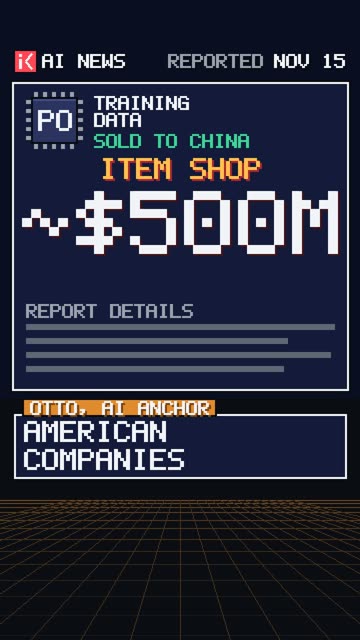
US data brokers are reportedly selling Chinese AI labs roughly half a billion dollars in reinforcement learning training environments.
Watch the short
Under a minute, read by an AI anchor. Made .
YouTube loads only when you press play.
American data companies are selling roughly half a billion dollars' worth of training data to Chinese AI labs, according to an investigation published by ChinaTalk on November 11, 2026. Some of that data takes the form of reinforcement learning (RL) environments: simulated worlds where a model practices a task such as coding, cyber work, finance, law or biology until its performance improves. The authors name Mercor, Surge AI, AfterQuery and Turing among the sellers. They say they found at least nine US vendors with Chinese customers in total.
An RL environment is easier to understand with an example. ChinaTalk describes a clone of PowerPoint that a model can use over and over, paired with a grading rubric that decides whether each attempt gets rewarded. Early attempts at building a slide deck are often poor, and the model improves as the rubric signals accumulate. For fuzzy goals like a good-looking slide, vendors hire experts, such as consultants and professional designers, to write the rubric and grade sample output. For coding, the data is often a company's real GitHub history: codebases with bugs, plus the fixes engineers wrote, so a model can be tested on whether it finds the fix.
The authors argue the risk comes from what these environments teach. A coding environment can also build skill in finding exploits and offensive cyber work. A biology environment could help with gene synthesis and bioweapon design. ChinaTalk says the line between acceptable and dangerous environments can be hazy. Buying an environment already used by a US lab also lets a Chinese lab avoid bugs, poorly graded rubrics and low-quality datasets that waste time and money. This matters more because rollouts, the attempts a model makes during RL, can take more than 70 percent of RL post-training time according to one study the authors cite. Rollouts rely on inference, which is memory-constrained. The authors say Chinese chips suffer more from a shortage of high-bandwidth memory (HBM) than from a lack of compute, so cutting that cost is worth more to Chinese labs.
Surge AI's website says its RL environments are "built by the same experts behind our frontier-lab work," a phrase the authors present as evidence of the pattern they describe. They also argue that RL is arguably more important than distillation, the cheaper method in which a Chinese lab trains on outputs from a stronger model such as GPT or Claude. The evidence on which stage matters most is mixed. ChinaTalk points to Mistral Large 4, where RL drove the gains, and to Xiaomi's MiMo-V2.6, where supervised fine-tuning produced more of the improvement.
The authors acknowledge that their sourcing is vague. Several claims rest on anonymous sources at Chinese labs, on contractor posts and on subcontractor practices. For Mercor, they cite data they were able to access showing an SWE RL environment sold to Alibaba, along with a Forbes report that 2 percent of its Q2 2026 revenue came from China. For AfterQuery, Forbes reported that about half of its $100 million in ARR comes from Chinese business, but the authors could not verify any sale independently. Their list is also incomplete. They could only find vendors through leaks and sloppy practices by subcontractors, often in India.
The legal picture is thin, according to the authors. Most vendors set their own customer policies, and in May 2026 Mercor narrowed its policy from an ownership test to a location test. RL environments are largely outside export controls, except for buyers on the Entity List such as Zhipu, and an affiliate outside China can get around that. Offshore contracting offers another route, since ByteDance's data-buying desks are in Singapore and San Jose. The existing US rules the authors list cover identifiable American data, medical data and large volumes of unidentified data. That may explain, the authors suggest, why China's young data industry has focused on healthcare data.
The authors propose two measures. The Bureau of Industry and Security could treat dual-use environments under its existing rules on chip design, cyberattacks and bioweapons, and send is-informed letters to vendors. The Department of War could tighten procurement rules through FAR and DFARS to stop contracted vendors from selling to worrying Chinese labs. They also call for better government visibility into vendor sales, noting that Chinese labs tend to buy in the same domains American labs have moved into. The post doesn't say how these measures would be enforced or what the government's current view is.
What changed
Type: Other · Applies to: Mercor, Surge AI, AfterQuery, Turing
Why it matters
Companies that sell or license training environments may face scrutiny over where that material ends up.
What you can do
Review export and data-brokerage terms for any training data or environments your firm sells or buys.
Original source
Further reporting
Where we saw it
THE DECODER
AI wrote this summary from the sources listed, and nobody reviewed it individually before publication. Check the original source before you rely on it. How it works